
Building the Infrastructure in Low Earth Orbit to Revolutionize Life on Earth
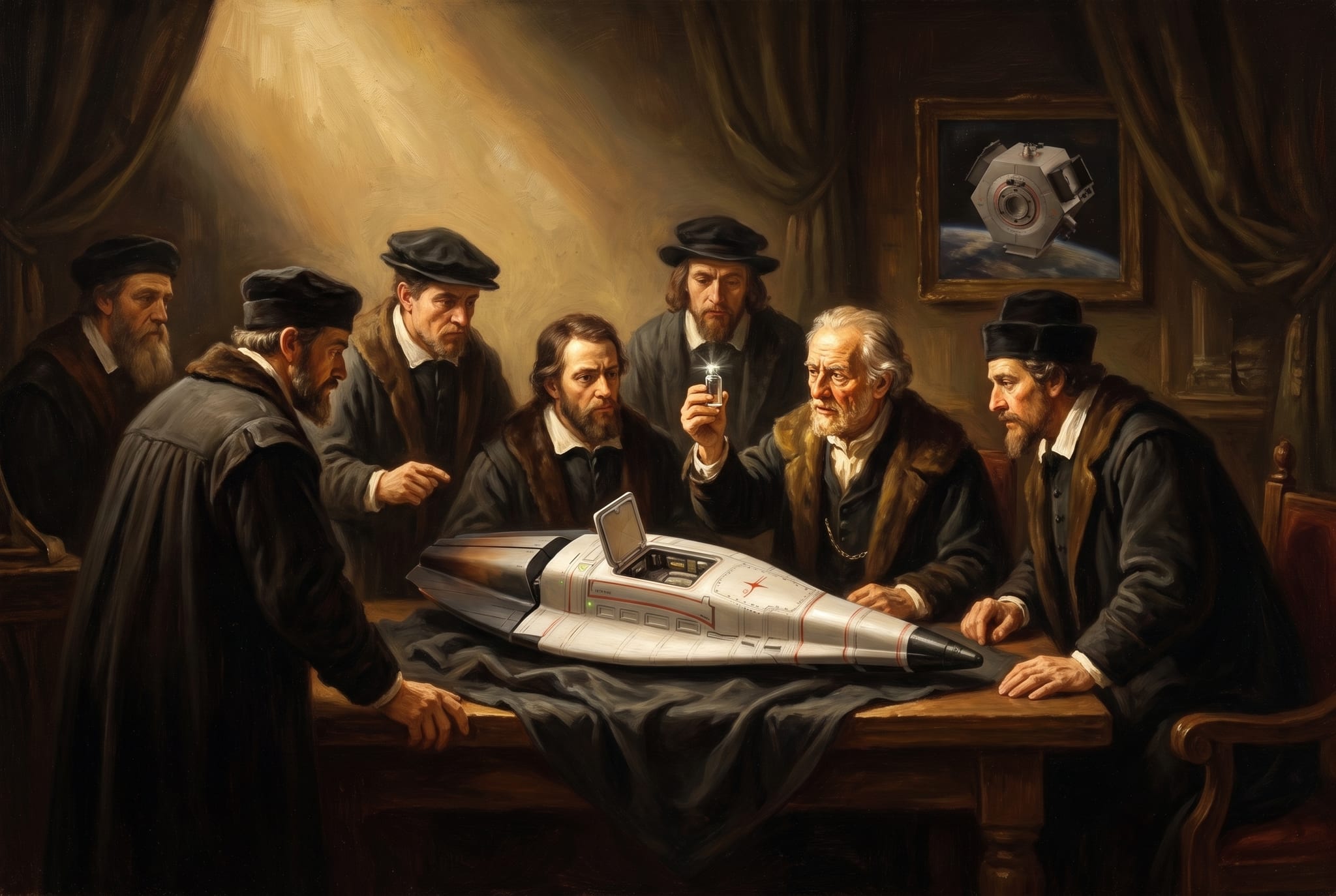
The best place to make a medicine is not on Earth.
That sounds like a provocation. It is a description of physics. Every process we use to develop a drug runs inside a gravity field. Crystals sink as they grow. Fluids stratify by density. Heat rises and stirs the solution around it. Cells pressed against a dish flatten into two dimensions. We spend enormous effort fighting these effects, and the fight is never fully won.
Four hundred kilometers up, the fight ends. In orbit, gravity does not pull, liquids do not settle, heat does not convect. Nothing sediments. Nothing vibrates. The vacuum outside is perfectly clean. On Earth we can reproduce a few of these conditions, one at a time, for seconds, in drop towers and parabolic flights. In orbit they exist all at once, for months.
The results are not subtle. Protein crystals grow larger and more ordered, which means better structures for drug design and purer formulations. Particles form at uniform size. Cells organize into tissue in three dimensions, without a scaffold, closer to how they behave in the body. These are not predictions. They have been demonstrated on the International Space Station for decades.
The question has never been whether microgravity works. The question is why almost no one can use it.
The scarcest laboratory we have
For most of the history of spaceflight, access to microgravity has been rationed. A biotech team that wants to run an experiment in orbit waits for a slot, competes for crew time, designs around a station built for research rather than production, and gets a few samples back whenever a capsule happens to return. The cycle takes years. A single flight can cost more than an entire program on the ground.
The result is a strange asymmetry. There are thousands of diseases that could benefit from research in this environment. Almost none have had it. The handful of companies that have flown have mostly flown once, learned something real, and then waited for a next opportunity that rarely came.
This is not a science problem. The science has been clear for a long time. It is an infrastructure problem, in the same way compute was an infrastructure problem before data centers, and genomics was before sequencing became cheap. The environment is extraordinary. The access is not.
When access is rare, people use it carefully, for small experiments with modest ambitions. When access becomes routine, they start building on it. That is the transition we care about.
What infrastructure means
Infrastructure is what turns a rare capability into a routine one. It is not a single breakthrough. It is a system that removes, one by one, the reasons something cannot be done at scale.
For microgravity, that system has three parts.
The first is a place to work. Tessera-1 is our orbital platform: a free-flying spacecraft in low Earth orbit that carries sealed modules where partners run research and production. Each module is a closed environment at one atmosphere, isolated from every other, with capacity reserved for one partner for a defined period. No crew to schedule around. No shared bench. The partner designs the experiment; the platform runs it.
The second is a way home. A result that stays in orbit is not a result. Thor XR-1 is our reentry vehicle. It docks with Tessera-1, takes on the finished modules, and brings them back to Earth on a schedule the partner can plan around. Not when a ride happens to be available. On a date.
The third is the loop between them. Samples go up, products come down, and the platform keeps flying. Every cycle makes the next one cheaper, faster, and more predictable. That is what separates infrastructure from a mission. A mission ends. Infrastructure compounds.
Think of a port. A single ship crossing an ocean is an expedition. A harbor with cranes, warehouses, and a published schedule is an economy. The ocean did not change. What changed is that crossing it stopped being the hard part.
Medicine first
We could have started with any of the things microgravity makes possible. We started with medicine because it is where the gap between what is possible and what is accessible is widest, and where closing it matters most.
Consider the simplest case. A protein-based drug that has to be given by intravenous infusion, in a hospital, over hours, because its molecules cannot be made stable enough at the concentration a single injection would need. Grow the crystals in orbit, where they form larger and more uniform, and the same molecule may fit in a syringe a patient uses at home. The medicine did not change. The environment changed what form it can take.
Or a tumor model grown in three dimensions, organized the way tissue organizes in the body rather than flattened on a plate. A better model means a better screen, which means fewer drugs failing late in clinical trials for reasons that could have been seen early.
Our partners bring the science. They know the disease, the molecule, the assay, the patient. What they have never had is the environment, on reserved capacity, with a vehicle that brings the work home on time. That is what we bring.
We do not need to become a pharmaceutical company to change what pharmaceutical companies can do. We need to be very good at the one part nobody else is building.
Earth is the point
It is easy to read a company that builds spacecraft as a company that wants to leave. We do not. Astreia exists to use space in Earth's service. Every kilogram we send up is sent up to come back, carrying something that could not have been made here.
We know how small these first steps are. A platform. A vehicle. A handful of sealed modules. Measured against the size of the problem, they are almost nothing. Measured against what has existed until now, they are the difference between an environment a few experiments a year can touch and one that thousands of diseases could finally reach.
The universe took thirteen billion years to produce us. We get about a hundred. It seems reasonable to spend some of them making the view from orbit useful to the people who will never see it.
That is the infrastructure we are building in low Earth orbit. Not to change life in space. To change life on Earth.